El Niño & Sydney Hobart 2026
Great Unknown – A record El Niño, and the 2026 Sydney Hobart

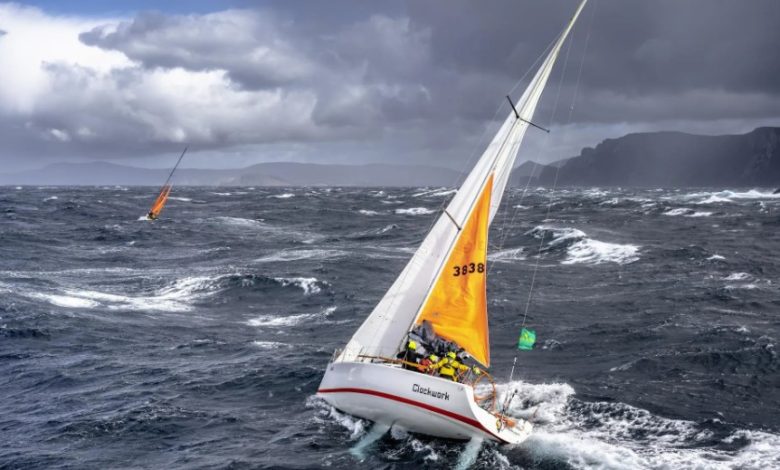
How’s that for conjecture? Talk about long-range forecasting! You know, there is something rather intriguing, and decidedly attractive about the prospect of a record-breaking El Niño presiding over the 2026 Rolex Sydney Hobart Yacht Race.
For all the technological wizardry, millions of dollars of investment, computational horsepower, and accumulated ocean racing experience that will be assembled on Sydney Harbour come Boxing Day 2026, the one participant that has never bothered to read the NoR is once again threatening to have the final say. Namely, the weather.

Attention paid during the final weather briefing by the Bureau of Meteorology – photo © Rolex / Stefano Gattini
From this standpoint in time, and as my home area goes into yet another week of enduring sogginess, what a peculiar beast this weather thing is proving to be. El Niño traditionally conjures images of parched Australian landscapes, relentless sunshine, the general absence of meaningful precipitation, and dare we say it, bushfires.
Yet 2026 is on track towards becoming Australia’s wettest El Niño year on record, according to ABC meteorologist Tom Saunders, as he recently reported on TV, referencing Bureau of Meteorology data. This is not merely an interesting statistical anomaly. It is a reminder that the atmosphere is a complicated place, and anyone seeking a simple correlation between the temperature of the equatorial Pacific, and the conditions awaiting a fleet of racing yachts all heading South to Ye Olde Hobart Town, is likely to be quite disappointed.

Changes in Pacific Ocean temperature patterns during El Nino/La Nina cycles have far-reaching consequences in other ocean basins, and remote impacts on the Indian monsoon and water resources in the South Asia region. (Illustration by Natalie Renier) – photo © Wood Hole Oceanographic Institution
The tropical Pacific has certainly been doing its bit to attract attention. By the week ending October 11, the Bureau’s relative Niño 3.4 sea-surface temperature index had reached plus 2.81 degrees Celsius, an exceptionally high weekly reading in its dataset that commenced in 2008. The Southern Oscillation Index was strongly negative, whilst climate models were suggesting further intensification towards November and December. Those are serious numbers, although the distinction between an exceptional weekly measurement, and an all-time record El Niño event is important, for the latter has not yet been established.
So here we are, just a little over two months from the start of the 628-nautical-mile Windward/Leeward to South, with the ocean-atmosphere system apparently determined to rewrite some of its own precedents. The obvious question is whether any of this tells us what the fleet might encounter once it clears Sydney Heads. The less obvious, but considerably more interesting question, is which boats might benefit from the different weather regimes that remain possible. There is no definitive answer yet, and that is precisely what makes the forthcoming contest so intriguing.

Wild Oats started well back, but recovered the lead at Sydney Heads – photo © Carlo Borlenghi
The lessons of A very ordinary Hobart
If there was one enduring lesson from the 2025 race, it was that the weather does not have to be especially unusual to produce an extraordinary result. The fleet encountered a substantial southerly opening, with uncomfortable seas along the New South Wales coast, followed by lighter conditions that transformed the corrected time contest. By the time the smaller boats were working their way down the Tasmanian coast, the tactical landscape had changed completely. The result was historic. Jiang Lin and Alexis Loison, double-handed aboard Min River, secured the Tattersall Cup, and in doing so became the first double-handed crew to win the race overall, while Lin became the first woman to claim that distinction. The achievement illustrated just how profoundly the timing of successive weather systems can influence the corrected-time results.
It was also a reminder that ocean racing remains an exercise in managing equipment, people, and expectations. URM Group retired with structural damage, Moneypenny experienced equipment problems, V5 suffered keel damage, and several boats withdrew because of injuries, seasickness, or rigging failures. These were not theoretical risks buried somewhere in a safety manual. They were the real-world consequences of taking high-performance yachts into an environment where the loads can build remarkably quickly.

URM Group with the rail stacked – photo © Bow Caddy Media
The meteorological briefing for the 2025 start had warned of southerly winds around 20 to 25 knots offshore (which turned out to be nigh on double that), with significant swell heights subsequently revised upwards to three or four metres. The interaction between the southbound East Australian Current and the incoming southerly sea was an important consideration, particularly between Jervis Bay and Montague Island. Some crews were obliged to make difficult choices between a favourable current and an unfavourable sea state. Others discovered that maintaining the boat’s integrity was considerably more important than maintaining a theoretical target speed.
That last point deserves particular attention as we contemplate 2026. The current crop of offshore racing yachts can produce staggering performance, and modern routing software can calculate optimum courses across an enormous range of potential weather outcomes. What it cannot guarantee is that the crew will be able to maintain the required performance when the sea state becomes punishing, or that the boat will emerge from the experience without damage. A yacht that sails at 95 per cent of its potential for the entire race will frequently outperform one that achieves 105 per cent for a few glorious hours before something expensive gives way. Now that’s hardly a new observation, but the Sydney Hobart has a particularly effective and demonstrative way of reinforcing it.

PredictWind weather routing 2025 Rolex Sydney Hobart as at 2000hrs on December 25, 2025 – photo © Predictwind
What El Niño actually means offshore
To understand the possibilities for December 26 and onwards, we need to distinguish between climate and weather. El Niño is a large-scale ocean-atmosphere phenomenon, associated with unusually warm waters across the central and Eastern tropical Pacific, and then changes to the atmospheric circulation above them. It very much can influence the position and intensity of weather systems over Australia, but it does not dictate the wind direction and sea state at Green Cape on December 27.
The distinction is fundamental. Seasonal climate outlooks describe shifts in probability across months, whereas offshore weather forecasting attempts to determine the development and movement of individual pressure systems over days. The first can provide useful background information about the prevailing climate regime. The second determines whether a navigator sets up for a long starboard-tack beat, a fast spinnaker reach, or something more lifeless or life threatening!

The BoM’s October long-range outlook illustrates the complexity. Despite the exceptionally strong El Niño, it anticipated above-average rainfall across parts of western, central, and Eastern Australia during November to January, whilst Tasmania and parts of Victoria were more likely to experience below-average rainfall. Temperatures were expected to be above average across much of the country, and surrounding sea-surface temperatures were also unusually high.
One might be tempted to translate this into a warmer, drier passage south, particularly once the fleet reaches Tasmania. That would be a mistake. Rainfall probabilities over land do not establish wind strength, wave height, or the position of a cold front offshore. A dry summer in Tasmania can still contain a thoroughly unpleasant 24-hour period for the transition from the mainland to the Apple Isle, just as a wet spring in Sydney can be followed by a perfectly benign Boxing Day.

The view from a saildrone sailing in a Southern Ocean storm. Saildrone’s USVs are designed to withstand the most challenging ocean conditions, without putting human health and safety at risk – photo © Saildrone
There are other important influences. The Indian Ocean Dipole can alter moisture transport across Australia. The Southern Annular Mode influences the latitude of the belt of Westerly winds and associated frontal systems. The position of the subtropical ridge determines the behaviour of high-pressure systems, while the Tasman Sea can generate its own complications through coastal troughs, lows, and changes in the pressure gradient.
Then there is the temperature of the water itself. The Bureau reported sea-surface temperatures around parts of Southern and Southeastern Australia running two to three degrees above average in early October. Warm water can provide additional moisture and even more crucially, energy to developing weather systems, although whether that translates into a significant offshore event depends on the atmospheric ingredients being present at the same time.

For the 2026 fleet, the important message is that the background environment contains some unusual ingredients, but we cannot yet determine what meal will be served. It could be a straightforward passage with moderate breezes, an exhausting sequence of transitions, or a more substantial encounter with one of the Southern Ocean’s travelling weather systems. All three remain plausible, and the most important forecast is still some weeks away.
The fleet, and the possibilities
The provisional entry list is already offering plenty to consider. As of entries closing, the official Rolex Sydney Hobart website lists 112 yachts, ranging from 100-footers to smaller offshore racing designs, along with a mixture of IRC and PHS entries and a substantial double-handed contingent of 23. It is a fleet with considerable depth, and importantly, one whose prospects could change markedly depending on the weather pattern that develops.

Master Lock Comanche begins the journey South to Hobart – photo © Bow Caddy Media
The pointy end always gets attention because of the scale and pace. SuperMaxi (nee LawConnect) is now InfoTrack once more and ‘Sailing For A Purpose’, namely the Starlight Children’s Foundation. There are familiarities to her original Speedboat form, but her latest prodder always STANDS OUT. A wonderful team, and of course, a previous Line Honours winner.
It is said that they have been working away on Comanche since March, and she is now Loyal, with new livery to prove it. Anthony Bell won and set the race record in 2016 on Perpetual Loyal, which is the very same boat in the preceding paragraph. Tom Slingsby OAM is the driver, with Andy Green as Navigator, Pablo Arrarte on board once more, and Liam Woulfe wearing the Mast Pro harness. As usual, celebs are involved, with ex-Wallaby Phil Waugh touted as one of them, as too Karl Stefanovic, so you’d have to think the PR machine will get cranking pretty soon… The Bird Island and Cabbage Tree Island races on the programme, as too The Maxi Champs.
Sail Number ITA70 is listed as Ichi Ban. Starting life as Ericsson 3, this vessel was the overall winner in 2024 for Sam Haynes and co as Celestial V70. Matt Allen AM has won the Tattersall Cup three times before, and also an earlier one with King Louie back in the day. He was also co-Skipper of the vessel in the paragraph above when it won Line Honours last year.
You also have Moneypenny, and former winner Alive, all there to do business once more. What last year proved is that without the blasting speed of a reach or run, the express department have to wait on what Huey serves up for the others before the shiny new watch gets handed out.

Moneypenny heads to sea – photo © Bow Caddy Media
Large, powerful yachts can generate enormous speed as they drag the apparent wind forward, and cover extraordinary distances when the breeze is suitably aligned. A strong Northerly running down the New South Wales coast, followed by a manageable transition over to Tassie, could create opportunities for the bigger boats to build the required substantial separation before the smaller competitors have properly settled into their second night.
However, a persistent Southerly would present a different proposition. Upwind performance, the ability to maintain speed through waves whilst looking after the craft itself, and the capacity to keep the crew operating efficiently become critical. The theoretical advantage of additional waterline length remains significant, but pounding into a short, steep sea can impose enormous structural loads and make sustained maximum performance difficult.
The larger yachts also face a particular problem when the weather changes quickly. Their speed can carry them into a different weather system from that experienced by the rest of the fleet. A yacht travelling at 20 knots can cover 240 nautical miles in 12 hours. One averaging seven knots covers only 84 nautical miles in the same period. That difference can mean encountering a front before it strengthens, sailing into the back of a high-pressure system, or arriving at the Derwent just as the breeze disappears. And that is where the overall race becomes particularly interesting.
The provisional list includes Smuggler, Gusto, and V5 among the TP52 contingent, together with Sticky, the Cookson 50, Mayfair, Pretty Woman, Chutzpah, and several other serious IRC propositions. The precise combinations of wind strength, sea state, and reaching angles will influence their performance, but the larger question is whether the weather permits them to maintain a high percentage of their rated potential across the entire course, which is why the race is known as the 628nm Windward/Leeward.
A moderate-to-fresh reaching race could reward the boats capable of maintaining sustained speed without excessive manoeuvring. A more variable event, with several changes in direction and intensity, might place greater emphasis on versatility, sail selection, and the efficiency of the crew. A long upwind passage could favour a different set of characteristics again, particularly if the sea state is manageable enough for the yachts to maintain their target speeds.
One should also avoid confusing outright speed with corrected-time competitiveness. IRC attempts to account for differences in yacht performance through a rating system, and the Tattersall Cup is decided by elapsed time corrected under that system. A yacht does not necessarily improve its overall prospects simply by being faster than its neighbours. It must sail sufficiently well relative to its rating, and the weather must provide opportunities to do so. This is why the middle of the fleet deserves at least as much attention as the spectacle at the front.
The little boats, and the long game
One of the great attractions of the Sydney Hobart is that it remains a race in which a relatively modest yacht, expertly sailed, can compete for the same overall prize as a vessel costing many millions of dollars. That is not simply a romantic notion designed to encourage entries. It is an essential characteristic of the race, and the 2025 result demonstrated its relevance, emphatically.
The 2026 entry list contains a fascinating collection of smaller IRC contenders, including Mistral, Toucan, Wyuna and Beautemps, along with Midnight Rambler, Magic, Titoki, and Inukshuk. Several are entered double-handed, bringing an additional dimension to the contest. The importance of these yachts lies partly in their ability to exploit weather that develops after the larger boats have passed through, or indeed finished. What it all illustrates is the extraordinary influence of timing on the Overall (IRC) result, particularly when a fleet contains yachts whose elapsed times may differ by several days.

Showdown – Drew Carruthers with the late and great Jim Close two-handed 2023 Sydney Hobart race – photo © Richard Bennett
The double-handed boats introduce another variable. Their crews must manage sail changes, navigation, sleep, food, and the mechanical demands of offshore sailing with only two people aboard. Modern autopilots and carefully developed watch systems make extraordinary performance possible, but they do not eliminate fatigue. Rough or benign, the challenges stem from having the bejesus belted out of you to being at your best when tedium takes hold The East Australian Current has not read the forecast, either.
The EAC deserves more attention than it sometimes receives, for it can provide a substantial Southbound advantage along the New South Wales coast, but its position, strength, and associated eddies are constantly changing. The Navigator who finds the right current structure can gain considerably, whilst one who assumes the main flow will remain conveniently positioned may discover otherwise. Equally, chasing it can often prove folly.
The problem is particularly acute when a strong Southerly wind opposes the Southbound current. The resulting sea state can become steep and confused, with shorter wavelengths and more violent boat motion than might otherwise be expected. Time to call the Breaker, and he is not Harry Morant.
The EAC may offer valuable assistance towards Hobart, yet the accompanying sea state can make it difficult to maintain speed and place additional strain on the boat and crew. A route farther inshore or offshore may be slower on paper but be considerably quicker in practice. It is a crucial layer to the overall mix, and last year you did see a lot of big boats tucked right up against the bricks, even though this is traditionally where the current is heading back up North.

Alan Hill in Cooloola’s companionway late yesterday – Sydney to Auckland Ocean Race – photo © Cooloola
There is also the matter of the weather models themselves. Modern routing software can compare multiple atmospheric solutions and identify a range of possible outcomes, but a single optimum track is only as reliable as the forecast on which it is based. Differences in the timing of a front, the movement of a high-pressure system, or the development of a coastal trough can alter the preferred route substantially. Hence the mantra, stick your head out of the companionway hatch…
Bass Strait, Tasmania, and the final reckoning
For all the attention devoted to the opening stages, the Sydney Hobart has an inconvenient habit of saving some of its most significant decisions until the fleet approaches Tasmania. Bass Strait proper can be a formidable stretch of water, particularly when strong winds build on established swell and shallow continental-shelf regions. So when it exits and hits the fleet in the Tasman Sea, it has used up all the fetch and funnel on offer to arrive like Thor’s Hammer. Yet it can also produce frustratingly light conditions when a high-pressure system settles over Southeastern Australia.

You could easily argue that there are four starts to the Hobart. The gun back in the Harbour, the Heads, Tasman Island, and the Iron Pot at the mouth of the River Derwent. As time goes by and boats got faster, Green Cape/Gabo Island has more than put up its hand as a contender for the fifth, for being in good position there, both geographically for the angle of transition, as well as boat and crew, can really set you up for the two thereafter.
Storm Bay can terrify, or torment. The River Derwent can have you looking for a candle to stick in the winch handle socket to determine of there is any breeze on offer, at all. At the same time, those coming down the coast can be obliterating your hard won assault on the IRC tables. Do remember, that in order to win the Hobart, first you have to win your Division, and then it is Huey who will determine who gets the gold that year.

The Caprice 40, Chutzpah (Bruce Taylor VIC) climbs the moving mountains of Storm Bay – 2022 Rolex Sydney Hobart – photo © Carlo Borlenghi
The 2026 El Niño does not resolve any of these uncertainties. Although the Bureau’s seasonal outlook currently favours below-average rainfall across much of Tasmania, that is not evidence of a particular wind regime during the race. A dry seasonal signal does not preclude a strong frontal passage, nor does it guarantee settled conditions around the Southeastern coast.
Indeed, one of the more important lessons from the unusual climate conditions of 2026 is that broad assumptions deserve considerable scrutiny. The atmosphere has already demonstrated that it is perfectly capable of producing substantial rainfall during an exceptionally strong El Niño. There is little reason to assume it will suddenly become more obedient when the fleet assembles on Boxing Day.

2017 Rolex Sydney Hobart start – photo © Carlo Borlenghi
So, what should we expect?
The extraordinary strength of the developing El Niño is meteorologically significant, but it cannot yet tell us whether the fleet will encounter a Southerly buster, a sustained Northerly, a sequence of frustrating transitions, or something altogether different.
What we can say is that the broader climate environment is unusual, regional sea temperatures are elevated, and the seasonal outlook contains competing signals that deserve monitoring. The interaction between El Niño, the Indian Ocean Dipole, the Southern Annular Mode, and the positioning of weather systems across Southern Australia will help shape the background conditions. The actual race weather, however, will be determined by the pressure systems moving across the Tasman Sea and Southern Ocean during the final days of December.
For the competitors, that means preparation must remain firmly grounded in the full range of conditions that the Sydney Hobart can deliver. Heavy-weather sails, rigging, steering systems, electrical reliability, crew endurance, and the ability to operate the boat efficiently when things become uncomfortable are not optional considerations, simply because a seasonal forecast appears favourable.
We’re left with an exceptionally strong El Niño, a rainfall pattern that challenges conventional expectations, an intriguing fleet, and a racecourse that has never been particularly interested in following the script. There is plenty to analyse, much to prepare for, and basically no justification for declaring the outcome in advance.
By the time the final weather briefing takes place on Boxing Day morning, the meteorologists should have a much clearer picture of the opening conditions. The Navigators will have their routing options, the Skippers will have made their decisions about sail inventories and crew preparation, and the various contenders will have calculated what they believe is required to win. Then the fleet will leave Sydney Harbour, and the ocean will begin marking their homework. As ever, the only forecast that really matters will be the one that turns out to be correct.
by John Curnow